Your phone buzzes at 03:00. A disk is full, a certificate has expired, a database has fallen over. You get an alert and the evidence from the terminal, and three things you could do about it. Pick the right one and you’re back in bed quickly. Pick the wrong one and you’re still up at breakfast.
It's 03:00 and your phone is buzzing. Five things are broken tonight and you're the only one awake. Pick the best fix for each. Good choices get you back to bed sooner.
How to play
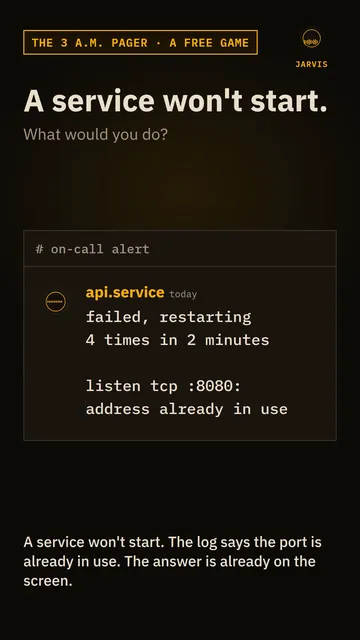
You get five alerts a shift, drawn from eight common incidents: a full disk, a service that won’t start, an expired certificate, an out of memory kill, a flood of failed logins, failing backups, a cron job that doesn’t run, and internal DNS that has stopped answering.
Each alert shows the terminal output you’d see. Read it, then choose what to do:
- A good fix costs 10 minutes on the clock.
- A fix that works but isn’t the best one costs 45 minutes.
- A bad one costs 2 hours, because it makes things worse or does nothing.
At the end you get a rank, the time you got back to bed and a row of coloured squares to share. Everyone who plays today’s shift gets the same five alerts, so you can compare scores. A random shift gives you a different set each time.
The game runs in your browser, and nothing about your choices is sent anywhere.
Want a quick look first? This Short shows one alert being played.
 Play the video: Can you fix it at 3 a.m.? A free on-call sysadmin game
What it practises
The right answers share a few habits that apply to real incidents too:
- Read the log or the command output before you act. In most of these alerts the answer is already on the screen.
- Fix the cause, not just the symptom. Restarting a service, deleting files or turning off an alert usually brings the problem back.
- Check that nobody got in before you decide a security alert is harmless.
- Don’t make a big, hard-to-reverse change when a small one will do.
Quick answers
Are the commands real?
Yes. The commands and their output are the kind you’d see on a Linux server, such as df, journalctl, ss, dmesg and crontab. The hostnames and addresses are made up.
Is there a leaderboard?
Not for this one. There’s a result to copy and share, and the daily shift lets you compare with friends.
Which game should I try next?
If you like reading logs under pressure, try Patch the fleet, where only three servers can be down at once. For commands, try the Linux escape room, and the full list is on the games page.
Related projects
3 pages